RISO Inks and Consumables | Detailed Explanation
Everything You Need for Your RISO Printer: Ink & Consumables (2026)
RISO makes two fundamentally different printing systems — and their consumables are not interchangeable. Whether you manage a ComColor high-speed inkjet machine or a Risograph digital duplicator, this guide covers every consumable you need: what it does, which part number fits your machine, what it is made of, how long it lasts, and how to source it without overpaying. Use the contents above to jump to the section most relevant to your machine.
RISO ComColor vs Risograph — Two Different Ink Systems Explained
One of the most common mistakes when buying RISO consumables is ordering ink designed for the wrong system. The RISO ComColor and RISO Risograph (also called a digital duplicator) are built on entirely different printing technologies. Their inks, ink formats, and additional consumables are specific to each system and cannot be substituted for each other.
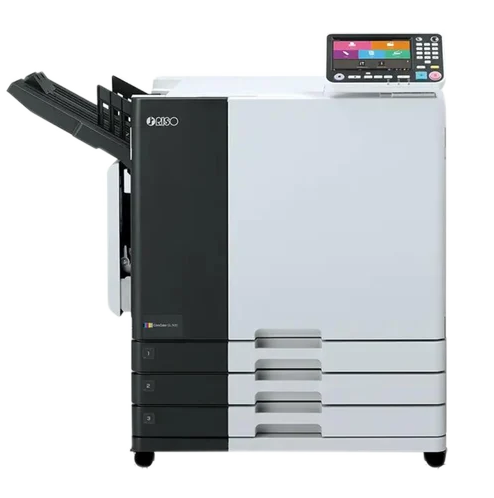
The ComColor is a high-speed color inkjet printer. It uses sealed 1,000ml ink cartridges in CMYK (and Gray on GL/GD series). There are no drums or masters — the only regular consumable is the ink cartridge itself, plus staples if you use a finisher unit. A ComColor prints full process color at up to 140 pages per minute.
The Risograph (or digital duplicator) is a stencil-based printing system. It requires three consumables working together: an ink cylinder loaded inside a color drum, a master roll that is burned for each new document, and the drum itself. A Risograph prints in one or two spot colors at a time — not full process color — but at very high speeds and very low cost per page for long print runs.
| RISO ComColor | RISO Risograph / Duplicator | |
|---|---|---|
| Print Technology | High-speed inkjet (line-type) | Digital stencil duplicating |
| Ink Format | Sealed cartridge (1,000ml) | Ink cylinder loaded into print drum |
| Ink Type | Oil-based pigment, CMYK | Rice bran / soy oil, spot colors |
| Color System | Full color process (CMYK + Gray) | 1–2 spot colors per run |
| Available Colors | Black, Cyan, Magenta, Yellow, Gray | 21 standard + 50 custom + special order |
| Speed | Up to 140 ppm (A4) | Up to 185 ppm (single color) |
| Regular Consumables | Ink cartridges (+ staples for finisher) | Ink cylinder + Master roll + Drum |
| Typical Users | Print shops, offices, schools, government | Schools, artists, short-run print, nonprofits |
| Example Models | GL9730, GD9630, FT5230, FW5230, X1 9150, CC 9050 | EZ, RZ, MZ, SF, CV, RE series |
RISO ComColor Ink Cartridges — Series by Series
ComColor machines use sealed 1,000ml ink cartridges — one per color channel. The cartridge format is consistent across all series, but the part numbers differ by machine generation. Ordering the wrong part number is the single most common purchasing error, and it results in a cartridge that physically fits the slot but causes a compatibility error on the display.
The GL and GD series use five colors — adding Gray to the standard CMYK set. This allows for smoother gradients and more accurate reproduction of black-and-white photographs, making these series popular in professional print environments. The FT, FW, X1, and CC series use four-color CMYK only.
All Chameleon compatible ComColor ink uses oil-based pigment with particle size ≤180nm and viscosity matched to OEM specification (10–11cp). Each batch is MOAH/MOSH certified for EU market compliance, and page yield is tested to ISO/IEC 24712. Yield at or above OEM per cartridge.
Click any model name in the table below to view the product page and pricing.
| Series | Models | Colors | Part Numbers | From |
|---|---|---|---|---|
| GL | GL9730 / GL7430 | CMYK+Gray | S-8446E – S-8450E | $70 |
| GD | GD9630 / GD9631 / GD7330 | CMYK+Gray | S-7280 – S-7284 | $60 |
| FT | FT5230 / FT5430 / FT5231 / FT2430 / FT1430 | CMYK | S-8929 – S-8932 | $70 |
| FW | FW5230 / FW5231 / FW2230 / FW1230 | CMYK | S-7250 – S-7253 | $60 |
| X1 | X1 9150 / X1 7150 / X1 3150 / X1 7110 | CMYK | S-6701 – S-6704 | $50 |
| CC | CC 9050 / CC 7050 / CC 3050 / CC 7010 | CMYK | S-6300 – S-6303 | $50 |

Actual yield varies by image density, paper stock, and print settings. Compatible yield at or above OEM per cartridge on all series.

RISO Risograph Ink — Colors, Types and How to Choose
Risograph machines do not use cartridges. Ink comes in sealed cylinders that are loaded directly into the color drum. The drum holds the ink internally and forces it through the master perforations during printing. When you change color on a Risograph, you swap the entire drum — not just the ink.
RISO Risograph ink is rice bran oil or soy oil-based — biodegradable, low odor, and fast-drying on most uncoated paper. The characteristic translucency of Risograph ink (compared to offset or digital ink) is a deliberate property of the oil base: it allows overlapping colors to mix visually on the page, which is why Risograph printing has become popular in art and design communities despite being a commercial print technology.
The F II Type is the current standard for most Risograph models including the EZ and RZ series. Earlier machines may use the F Type format. Always confirm your machine model before ordering, as the two formats are not interchangeable.
21 standard colors are available off the shelf. Special and custom colors — including corporate brand colors matched to specific Pantone references — can be produced on request. View Chameleon F II compatible ink →
21 standard colors shown above (partial). 50+ custom colors available. Special order-made colors for corporate branding on request.
Ink Composition — What Oil-Based Pigment Ink Is Made Of
Both ComColor and Risograph ink are oil-based, which is what distinguishes RISO printing from water-based inkjet and toner-based laser printing. The oil base is not just a carrier fluid — it controls the dry time, viscosity, water resistance, and environmental profile of the ink. Understanding the composition helps you evaluate whether a compatible ink supplier's product is genuinely equivalent to OEM, or just priced similarly.
The chart below shows the approximate composition of a certified Chameleon compatible ComColor cartridge. The exact ratios vary by color — black cartridges typically carry a higher pigment concentration than color cartridges to achieve sufficient optical density for text.
RISO Masters — What They Are and When to Replace
A master (also called a stencil or master roll) is the consumable that makes Risograph printing work. Before each new document is printed, the duplicator burns a fresh master — a thin thermoplastic film perforated by a thermal print head to match the image being printed. The perforated master is then wrapped around the ink drum automatically, and ink inside the drum is forced through the holes onto paper as the drum spins.
Each print job requires a new master. When the job is complete, the used master is stripped from the drum and ejected into the master disposal box inside the machine. The disposal box holds a limited number of used masters and must be emptied regularly — a full disposal box will stop the machine and prevent new masters from being made until it is cleared.
Master rolls are format-specific. The most common current format is the F II Type, which is compatible with most EZ, RZ, and later MZ series machines. Earlier machines may require the F Type format. Always confirm your machine model before ordering, as the two formats differ in dimensions and are not interchangeable.
Storage matters for master rolls. Keep sealed in original packaging in a cool, dry environment below 25°C. Exposure to high humidity or direct sunlight can cause the thermoplastic film to degrade, resulting in poor master quality and reduced print sharpness.
F II Type
Current standard for EZ, RZ, and MZ series Risograph machines. Most widely available format.
F Type
Older format for legacy SF and early series duplicators. Confirm your machine model before ordering.
Replacement Trigger
The machine displays a low master warning when the roll is nearly empty. Do not allow the roll to run out mid-job.
Disposal Box
Empty the used master disposal box when prompted. A full box prevents master making and stops the machine.


RISO Print Drums — Function and Lifespan
The print drum (also called a cylinder) is the structural core of a Risograph machine. It holds the ink cylinder inside and carries the master wrapped around its outer surface during printing. As the drum rotates at high speed, centrifugal force pushes ink from inside the drum through the master perforations and onto the paper passing beneath.
Each drum is color-specific — a Black drum holds black ink, a Red drum holds red ink, and so on. Changing the print color means physically swapping the drum for a different color unit. This is a deliberate design choice: it allows the ink to remain sealed inside the drum between print jobs for weeks or months without drying, since the drum itself acts as a sealed reservoir.
Under normal operating conditions, a Risograph drum is not a frequent consumable. A well-maintained drum can last for millions of prints. However, drums do require replacement in specific situations. The chart below shows the four main replacement triggers ranked by urgency.
Drums are matched to machine series and are not interchangeable between series. An SF series drum does not fit an EZ series machine, even if the external dimensions appear similar. Always confirm both your machine model and the drum color when ordering a replacement.
OEM vs Compatible RISO Consumables — Cost, Quality and Risk Compared
The price gap between OEM and certified compatible RISO ink is not a reflection of inferior materials — it is structural. OEM ink pricing includes brand premium, multi-tier distributor margins, and R&D cost recovery built into the price of every cartridge. Compatible ink manufactured directly in the same factory environment, tested to the same ISO standards, and certified to the same EU regulations costs significantly less because the distribution chain is removed entirely.
The risk with compatible ink is real but specific: it is concentrated in uncertified products with unknown particle size and unverified viscosity. A certified compatible ink with documented particle size, viscosity data, and MOAH/MOSH certification carries the same practical risk profile as OEM under normal operating conditions. The comparison below uses GL series Black as the reference cartridge.
Savings calculated against published OEM distributor pricing. Actual savings vary by region and order volume. Volume discounts available from 300 units.
MOAH, MOSH and RoHS — Why Ink Certification Matters
If you source ink for the European market — or import ink through European distribution channels — certification is not optional. The EU introduced binding mineral oil safety requirements for printing inks in 2022 under a food contact materials regulation. Ink that does not meet MOAH and MOSH limits can be detained or destroyed at customs, regardless of whether the ink is OEM or compatible.
MOAH (Mineral Oil Aromatic Hydrocarbons) and MOSH (Mineral Oil Saturated Hydrocarbons) are two categories of mineral oil contaminants that can migrate from printed materials into food packaging and cause health concerns. The EU April 2022 decree set specific limits on both in printing inks. Third-party laboratory testing is required to demonstrate compliance — a manufacturer's self-declaration is not accepted.
RoHS 2.0 (Restriction of Hazardous Substances) is the broader EU directive that restricts the use of specific hazardous materials including lead, mercury, cadmium, and certain flame retardants. For printing ink, RoHS compliance means the formula has been tested and confirmed to contain no restricted substances above threshold limits.
When evaluating any compatible ink supplier, ask for three documents before placing an order: the original MOAH/MOSH certificate with the issuing laboratory name, certificate number, and issue date; the ISO/IEC 24712 yield test report; and the chip compatibility list specifying which printer models have been validated. A supplier who cannot provide all three is not operating at a professional standard and represents a genuine procurement risk.
Frequently Asked Questions About RISO Consumables
ComColor Consumables
FAQ About Chameleon Oil Based Ink